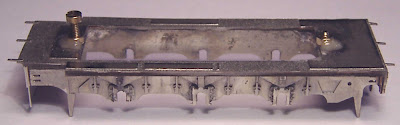
The footplate overlay etch has to be secured onto the underframe. It must remain flat for a quality result, I’m told. A bad start when I cut it from the etch and it springs into a banana-shape.

There are holes for screws at each end to secure it to the chassis. My kit included 10BA screws but I’d ordered some 12BA as these were recommended by others building this kit.
Think my best chance of a secure join is a generous portion of Araldite with the screws locating it in place. Once set I check that the sections are still electrically isolated, then have to file away the excess glue squirting out the sides.
I’d filed the PCB footplate side smooth earlier, but now I look again there are a couple of places still looking a bit uneven. I fill these with a smear of superglue and file away when set.
The photo shows that the edge is still not as smooth as I’d like. This will be very obvious on the finished model, so I give it a few strokes of fine wet and dry paper. This photo also shows a gap where the PCB footplate is shorter than the etch. I need to make up the front steps to check the correct length.
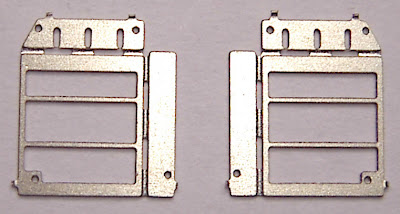
Laying the steps in place, turns out the clearances are very tight here. I have to file the footplate back to make room for the steps.
The steps shouldn't protrude forwards beyond the front bufferbeam. I've filed the footplate right back so the steps will be in contact with the front sandboxes (to fit in those recesses on the side frames).
Finally the nuts have to be soldered over the holes in the overlay. Wanted to be sure I got this exactly right so I tried to solder around the outside of the nut with the screw already through it. Hopeless - as I half-expected, I soldered the screw onto the nut. Found it much easier with quick-setting glue. I hadn't really used this stuff in the past, but I'm definitely getting to like it.
 coupling rod etch

 the lower rod here has been trimmed


